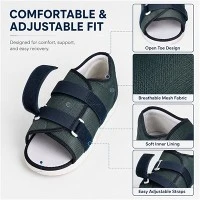
Preventive nursing measures for foot sagging:
(1) Bedrest period: Keep the limbs in a functional position and do not let the feet hang in the air. Change position, change every 2 hours, and adjust lower limbs to maintain mild flexion while lying down. Place a soft cushion on the foot, bend the affected hip and knee while lying flat, and place the foot on the cushion to press it firmly. When lying on the side, a soft cushion should be placed under the foot of the affected side, and there should be support on the back. The knee on the hemiplegic side should be supported to maintain the lower limb in a functional position and ensure that the hemiplegic side does not rotate outside. During sleep, cloth shoe therapy can be used, which involves fixing the affected side's cloth shoes vertically onto the patient's bed railing. Every night before going to bed, the affected side's foot is placed in the shoes and massaged every 2-3 hours by removing it from the shoes.
(2) Limb movements: Passive flexion and extension movements are performed on the joints of the paralyzed upper and lower limbs, while dorsiflexion movements are performed on the foot joints. Each set of movements is performed twice a day for 15 times. To promote passive movement on the paralyzed side, automatic movement on the healthy side also operates in the same way. If the passive movement is not sufficient, the healthy side can be used to drive the affected side to perform passive movement.
(3) Off bed period: Wheelchair riding training: After the acute period, with the permission of the doctor, wheelchair riding training can be started once a day for 5 minutes. If the wheelchair is stable, the time can be extended and the frequency can be increased. When using a wheelchair, both feet must be placed on the pedals. Patient safety must be taken into consideration. Patients who cannot maintain stability in their neck by securing their torso with seat belts can use wheelchairs with beds.
(4) Sitting training: Targeting patients who can sit in a wheelchair, this training is conducted twice a day, with the soles of the feet resting on the wheelchair pedals and maintaining a functional position.
(5) Walking period: Perform dorsiflexion training with the sole of the foot on the ground while using a wheelchair or sitting. Place a 5-6 cm sponge between the sole and the ground for dorsiflexion training, 10 times per set, twice a day.
Preventive measures for muscle atrophy
1. The prevention of muscle atrophy is achieved through active exercise training, such as sitting, standing, and walking exercises. According to the condition, corresponding guidance, massage, qigong, as well as traditional physical exercise methods such as Wuqinxi and Baduanjin can be selected. The method of daily homework is more practical and easy to learn. For individuals with upper limb mobility disorders, methods such as writing, throwing, catching balls, playing the piano, weaving, and playing abacuses can be used. For those with limited lower limb mobility, training methods such as riding tricycles and sewing can be employed.
2. Physical activity function training can be divided into two types: active practice and passive practice, with different contents such as traditional sports training and daily homework training. If the limbs are thin and withered, unable to move, and unable to walk, passive exercises in a lying position can be used during the bed rest stage, changing positions at any time to prevent "deformities" from occurring. Subsequently, active practice training will be adopted, such as sitting, standing, and walking exercises. According to the condition, corresponding guidance, massage, qigong, as well as traditional physical exercise methods such as Wuqinxi and Baduanjin can be selected. The method of daily homework is more practical and easy to learn.
Preventive measures for preventing joint stiffness
1. In the early stage of fracture (within 2 weeks), patients can be guided to perform ankle dorsiflexion and quadriceps isometric contraction exercises from the date of traction. And massage the knee to relieve local muscle tension and prevent hip bone adhesion from causing knee joint stiffness.
2. Mid stage of fracture (3-6 weeks), during which the swelling and pain disappear, the fracture is relatively stable, and the exercise range can be appropriately increased. In addition to early exercise projects, hip and knee range of motion can be increased. The method involves pedaling the bed with healthy feet, supporting the bed with both hands, lifting the hips, and sliding the lower body and affected limb together with the traction hammer up and down to enhance muscle strength and hip and knee range of motion.
3. In the late stage of fracture (6 weeks later), the fracture has basically healed. After the traction is released, the joints should be moved on the bed first. The method is as follows: the patient lies on their back, stretches the affected limb, slowly lifts and lowers it, and repeats this process; Or lie on your back, bend and straighten the affected limb repeatedly, and after 1-2 weeks, you can use crutches to get out of bed and walk without carrying any weight. At the same time as getting out of bed, patients can be guided to use traditional Chinese medicine to fumigate and wash the knee and ankle joints, in order to relax muscles, promote blood circulation, reduce swelling, and restore normal range of motion of the joints in a short period of time.