Nursing guidelines for preventing foot sagging
The concept of foot sagging, also known as pointed foot, refers to the symptom of ankle joint inability to dorsiflexe due to low muscle strength of the tibialis anterior muscle group, spasms of the triceps muscle, and contractures of the heel key; Clinical manifestations: Unable to dorsiflexe the foot, dragging the affected foot or lifting the lower limb on that side while walking, always touching the ground with the foot tip when landing. Therefore, during the swing phase of the walking cycle, patients are unable to complete ankle dorsiflexion and develop a characteristic foot drop gait.
Assessment: Patients at high risk of developing foot drop: paraplegia, common peroneal nerve injury, traction, and lower limb plaster fixation patients.
Preventive care measures:
(1) Bed rest period: Keep the limbs in a functional position. When the patient is lying in bed, whether in a supine or lateral position, the feet should not be suspended. Do not place heavy objects such as clothing on the blanket. The blanket at the end of the bed should be relaxed and supported by a support frame if necessary. Change position, change every 2 hours, adjust lower limbs to maintain a mild flexion position. Place a soft cushion on the foot, bend the affected hip and knee while lying flat, and place the foot on the cushion to press it firmly. When lying on the side, a soft cushion should be placed under the foot of the affected side, and there should be support on the back. The knee on the hemiplegic side should be supported to maintain the lower limb in a functional position and ensure that the hemiplegic side does not rotate outside. T-shaped shoes can be used during sleep. Every night before going to bed, place the affected foot into the shoe and massage it out of the shoe every 2-3 hours.
(2) Limb movements: Passive flexion and extension movements are performed on the joints of the paralyzed upper and lower limbs, while dorsiflexion movements are performed on the foot joints. This is done twice a day, with 15 movements per set. To promote passive movement on the paralyzed side, the healthy side can also perform the same automatic movement, or use the healthy side to drive the affected side to perform passive movement.
(3) Bedding period: After the acute phase, with the permission of the doctor, wheelchair riding training can be started once a day for 5 minutes each time. If the wheelchair is stable, the time can be extended and the frequency can be increased. When using a wheelchair, both feet must be placed on the pedals. Patient safety must be taken into consideration. Patients who cannot maintain stability in their neck by securing their torso with seat belts can use wheelchairs with beds.
(4) Walking period: Perform dorsiflexion training with the sole of the foot on the ground while using a wheelchair or sitting. Place a 5-6 cm sponge between the sole of the foot and the ground for dorsiflexion training, 10 times as a complete set, 2 times a day.
rehabilitation training:
(1) Starting with passive exercise, perform flexion and extension activities from the ankle joint to the interphalangeal joint. The technique should be gentle and the force should increase from small to large, twice a day for 20-30 minutes each time. When the patient's muscle strength reaches level 2
When going up, active foot flexion and extension activities can be performed gradually after passive activities. When the patient is able to stand, they should start from the platform and practice walking only when they can use both feet to firmly rest on the ground without tilting. And pay attention to gait to ensure it meets physiological requirements.
(2) Walking training: Encourage and guide patients to get out of bed, stand up, and engage in activities as soon as possible. When getting out of bed and standing up, one should gradually follow their own situation. You can first stand on the bed and try to keep your heels in contact with the ground while standing. At the same time, do squatting and walking exercises to gradually increase walking time.
(3) Foot Thermal Therapy: This is the use of physical effects to heat up tissues and then cool them down, promoting inflammation absorption, increasing local nerve nutrition, relieving muscle spasms, and reducing swelling. The specific method is to soak the affected foot in 38-40 degree warm water for 8-10 minutes first, and then soak it in 15-20 degree cold water for 8-10 minutes, repeated 3 times a day, twice a day, for 1-2 months.
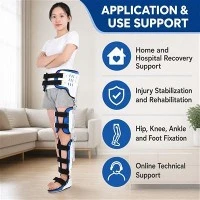
(4) Other methods include using ankle foot orthotics, sagging orthotics, calf orthotics, or using anti rotation shoes to prevent foot sagging, with significant results.