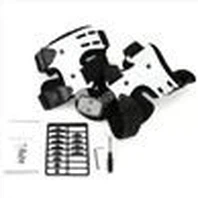
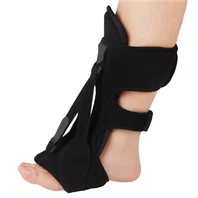
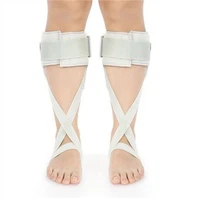
In the fields of sports medicine and rehabilitation, selecting an ankle brace requires consideration of injury type, severity, sport-specific demands, and biomechanical protective mechanisms. Below is a professional analysis of ankle brace classifications and their clinical applications based on industry expertise:
1. Medical Classification of Ankle Braces and Functional Mechanisms
(1) Dynamic Stabilization Braces
Core Function: Provide dynamic compression and proprioceptive feedback through elastic materials or adjustable straps. These braces limit excessive inversion/eversion (medial/lateral instability) while preserving physiological dorsiflexion/plantarflexion (up-down movement).
Clinical Applications:
Mild to moderate ankle sprains (Grade I-II ligament injuries).
Injury prevention in high-risk sports (e.g., basketball, soccer).
Support for chronic ankle instability during daily activities.
Design Features:
Materials: Elastic fabric, nylon straps, silicone pads (for anti-slip friction).
Biomechanical Rationale: Reduces ligament load by restricting range of motion (ROM) and enhances neuromuscular control by stimulating cutaneous mechanoreceptors.
(2) Semi-Rigid Braces
Core Function: Combine hinges or rigid lateral supports to restrict non-physiological ankle motion while allowing sagittal plane (forward-backward) movement.
Clinical Applications:
Moderate to severe ankle sprains (Grade II-III ligament injuries).
Post-surgical rehabilitation (e.g., after anterior talofibular ligament repair).
Protection against external impacts in high-contact sports (e.g., rugby, skiing).
Design Features:
Materials: Thermoplastic, aluminum hinges, EVA foam padding.
Biomechanical Rationale: Reduces inversion torque via mechanical blocking, minimizing reinjury risk.
(3) Rigid Immobilization Braces
Core Function: Fully restrict ankle movement for acute-phase protection or fracture healing.
Clinical Applications:
Acute ankle fractures (e.g., lateral malleolus fractures).
Severe ligament tears or post-surgical immobilization.
Design Features:
Materials: Carbon fiber, hard plastic shells, pneumatic chambers (e.g., air-inflated braces).
Biomechanical Rationale: Reduces soft tissue tension through rigid fixation to promote healing.

2. Injury Phase and Brace Selection Principles
(1) Acute Phase (0–72 Hours)
Goal: Control swelling and protect injured tissues.
Brace Type:
Rigid braces (e.g., walking boots) combined with the RICE protocol (Rest, Ice, Compression, Elevation).
Pneumatic braces (e.g., Air Stirrup) for gradual weight-bearing.
(2) Subacute Phase (3 Days–6 Weeks)
Goal: Gradually restore mobility while preventing joint stiffness.
Brace Type:
Semi-rigid braces: Provide protected ROM (e.g., limiting dorsiflexion to 10°–20°).
Dynamic stabilization braces: For low-intensity training.
(3) Recovery Phase (6+ Weeks)
Goal: Return to sport and prevent reinjury.
Brace Type:
Dynamic stabilization braces combined with proprioceptive training (e.g., balance boards, single-leg stands).
Taping-brace combinations: Reduce risk in competitive sports.
3. Sport-Specific Biomechanical Requirements
High-Impact/Lateral-Movement Sports (Basketball, Soccer):
Braces must limit inversion (to protect lateral ligaments) while allowing rapid directional changes.
Prioritize semi-rigid or dynamic strap-based braces.
Endurance Sports (Long-Distance Running):
Avoid excessive restriction of plantarflexion (to preserve push-off efficiency).
Opt for lightweight elastic braces or compression sleeves.
Contact Sports (Wrestling, Martial Arts):
Require shear-resistant designs to prevent joint dislocation from external forces.
Braces with rigid lateral supports and hinges are preferred.
4. Industry Consensus and Controversies
Evidence-Based Findings:
Systematic reviews (Cochrane, 2021) show semi-rigid braces reduce ankle reinjury rates by 50% compared to no bracing.
Dynamic braces outperform rigid braces in improving proprioception (JOSPT, 2019).
Controversies:
Long-term brace use may weaken periankle muscle activation (requires concurrent rehabilitation).
Professional athletes' brace acceptance is limited by sport regulations (e.g., bans on external rigid braces in some leagues).
5. Key Parameters for Clinical Decision-Making
Ligament Injury Grading (Ottawa Ankle Rules):
Grade I: Mild strain → Dynamic braces.
Grade II: Partial tear → Semi-rigid braces.
Grade III: Complete rupture → Transition from rigid to semi-rigid braces.
Ankle ROM Assessment:
Limited dorsiflexion (<10°) requires braces that avoid over-restriction.
Foot Biomechanics Evaluation:
High arches (rigid feet) need additional cushioning; flat feet (flexible feet) require medial arch support.