Comparison of the effectiveness of conventional AFO and active AFO usage
Objective: To compare the effects of conventional AFO and active AFO on ankle dorsiflexion ROM and gait. Method: Ten patients with simple foot drop (6 with sciatic nerve injury and 4 with common peroneal nerve injury) were divided into two groups and treated with conventional and active AFOs, respectively. The effects of the two orthotics on the ankle joint ROM and span of the patients were observed. Result: Compared with conventional AFO, active AFO showed a more significant improvement in ankle dorsiflexion (p 0.05) and a larger healthy leg span (p 0.05). Conclusion: The use of active AFO has a better improvement effect on the ROM and span of ankle dorsiflexion in patients than conventional AFO. Keywords: Conventional AFO, Active AFO, Foot Drop. Both central and peripheral nerve damage can cause foot drop, affecting joint range of motion and gait, and limiting daily activities such as walking. Some scholars have studied that AFO can improve gait in patients with foot drop [1], but some patients are unwilling to use orthotics, believing that wearing them is uncomfortable, limits the range of ankle joint movement, and affects the span of the healthy leg when supporting the affected leg. Therefore, some improved AFOs [2] have been derived to broaden the application range of orthotics, improve the comfort of some orthotics, and make them more targeted. This article focuses on observing the effects of two ankle foot orthotics, active afo [3] and conventional afo, on ankle joint ROM and span in patients with peripheral nerve injury. Materials and Methods: General information: 10 patients with simple foot drop, including 6 cases of sciatic nerve injury and 4 cases of common peroneal nerve injury, 8 males and 2 females; Age range: 23-51 years old, 2-8 months after injury. All patients have no joint contracture deformity and have independent walking ability. Method: Among the 5 patients, there were 4 males and 1 female, including 3 cases of sciatic nerve injury and 1 case of fibular injury
Two cases of total nerve injury were treated with conventional AFO, forming the conventional AFO group. There are another 5 patients, 4 males and 1 female, including 3 cases of sciatic nerve injury and 2 cases of common peroneal nerve injury. They are equipped with active AFO and belong to the active AFO group. Both groups received the same rehabilitation treatment: ① weight-bearing training on the affected side, with a shift in center of gravity; ② Self traction of the affected gastrocnemius muscle; ③ Maintaining range of motion near joints and muscle strength training; ④ Gait training; ⑤ Wear orthotics for 23.5 hours a day, excluding cleaning time. After one month, the visual analysis method in gait detection [4] was used to observe whether there were differences in ankle dorsiflexion ROM and gait between the two groups.
After wearing orthotics and treating for one month, the results showed that compared with conventional AFO, active AFO had a more significant improvement in ankle dorsiflexion (p 0.05) and a larger healthy leg span (p 0.05).
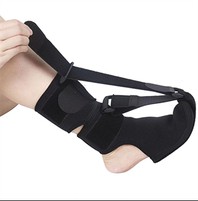
Discussing foot sagging caused by nerve damage, if not intervened properly in a timely manner, can lead to muscle atrophy and joint deformities. Due to the loss of nerve control, the ankle joint cannot actively dorsiflexe, and AFO is an effective assistive device to prevent ankle plantarflexion deformity. It can fix the ankle joint in a neutral position, assist patients in walking, and provide sufficient stability to the ankle joint. However, because conventional AFO fixes the foot in a neutral position, it also affects the normal ROM of ankle dorsiflexion. After long-term use, the angle of ankle dorsiflexion can only be maintained at around 5 °, which affects gait. In the late stage of swing of the healthy leg, the ankle joint of the affected leg is fixed by AFO, affecting the span of the healthy leg. The active type AFO has artificial joints in the ankle, which only restrict the ankle joint from plantar flexion, but allow for partial dorsiflexion movement. Therefore, in addition to the role of conventional AFO orthotics, it can also better maintain ankle dorsiflexion and improve gait for patients.