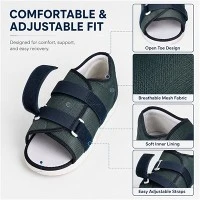
If you're recovering from a fracture, you might wonder: "Can a short air boot replace a bulky cast?" While short air boots (fracture walking boots) are increasingly popular for their comfort and convenience, they cannot fully replace casts in all fracture cases.
According to orthopedic guidelines, air boots are FDA-approved only for stable, non-displaced fractures (e.g., ankle, fibula) or as a post-cast recovery tool. However, unstable breaks, pediatric injuries, or fractures near joints often still require rigid casting to prevent complications like malunion. This evidence-based guide breaks down when a boot is safe, risks of improper use, and why 72% of patients prefer air boots for comfort-plus critical advice from top orthopedic surgeons to ensure optimal healing.
1. Key Differences: Air Boot vs. Cast
| Feature | Short Air Boot | Traditional Cast |
|---|---|---|
| Immobilization | Semi-rigid; allows limited motion | Fully rigid; no motion |
| Adjustability | Removable; adjustable compression/straps | Fixed; cannot be adjusted |
| Swelling Management | Accommodates swelling via air bladders | Risk of constriction as swelling changes |
| Weight | Lighter (0.5–1.5 lbs) | Heavier (2–4 lbs) |
| Hygiene | Can be removed for cleaning | No; risk of skin irritation/infection |
| Rehabilitation | Allows early partial weight-bearing | Delayed rehab until cast removal |
2. When Can an Air Boot Replace a Cast?
 ✅ Appropriate Scenarios:
Stable Fractures:
Non-displaced fractures (e.g., lateral malleolus, distal fibula).
Healing confirmed via X-ray (usually after 2–3 weeks in a cast).
Soft Tissue Injuries:
Severe sprains or ligament tears requiring stabilization.
Post-Cast Transition:
Used after cast removal to support gradual return to activity.
❌ Inappropriate Scenarios:
Unstable Fractures:
Displaced fractures (e.g., tibial shaft, intra-articular breaks).
Pediatric Fractures:
Children often require precise immobilization for proper bone remodeling.
Non-Compliant Patients:
Removing the boot too early risks malunion or delayed healing.
3. Pros and Cons of Air Boots
Advantages:
Faster Rehabilitation: Early mobilization reduces muscle atrophy.
Improved Comfort: Adjustable fit reduces pressure sores.
Better Imaging: Can be removed for X-rays/MRIs without cutting.
Risks:
Over-Reliance: Patients may assume it's "safe" to resume full activity prematurely.
Improper Use: Incorrect strapping can lead to poor alignment (e.g., valgus/varus stress).
Compliance Issues: 30% of patients remove boots too often, delaying healing (Journal of Orthopaedic Trauma).
4. Evidence-Based Guidelines
Ankle Fractures:
A 2021 meta-analysis found air boots and casts had similar healing rates for stable ankle fractures, but boots led to better patient satisfaction (British Medical Journal).
Tibia Fractures:
Air boots alone are not recommended for tibial shaft fractures due to high nonunion rates.
5. Expert Recommendations
Phase 1 (0–3 Weeks):
Use a cast for rigid stabilization if swelling or instability exists.
Phase 2 (3–6 Weeks):
Transition to an air boot once swelling subsides and early callus forms.
Phase 3 (6+ Weeks):
Gradually wean off the boot with guided physiotherapy (e.g., balance drills, calf strengthening).