Research progress of knee joint orthotics
Abstract: This article discusses the concept, classification, application effects, and domestic status of knee joint orthotics.
【 Keywords 】 Knee joint; Orthotics; Rehabilitation therapy; exercise therapy; classification
Significant progress has been made in the internal and surgical treatment of various knee joint diseases, and the rehabilitation issues after treatment have also received increasing attention from people. With the development of various rehabilitation medical technologies, modern materials science, and biomechanics, modern knee joint orthotics are gradually becoming more diverse. This article provides a review of the progress of knee joint orthotics.
The concept of orthotics
Orthoses are extracorporeal devices used to alter the skill characteristics or structure of the nervous, muscular, and skeletal systems. Orthotics have a long history. More than 370 BC, the father of Western medicine, Hippocrates, proposed the principle of fixing fractures with super joints. In the past, there were many names for orthotics, including Brace, Splint, Orthopedic device, Orthopedic appliance, and Supporter internationally. It was also known as a bracket, auxiliary device, etc. in China. Until 1960, the American Orthopaedic Surgeons (AOSP), the American Academy of Prostatic Orthopaedic Implementation Education Committee (POIEC), and the American Prostatic Orthopaedic Implementation Association (APOIA) jointly developed a systematic terminology for prosthetics and orthotics. Knee joint orthotics are one of them, which are specialized orthopedic devices used to treat various knee joint functional disorders. With the development of modern rehabilitation medicine, orthotics, along with physical therapy (PT), occupational therapy (OT), and speech therapy (ST), have become one of the four equally important rehabilitation techniques.
Classification of knee joint orthotics
There are various classifications of knee joint orthotics, which can be classified into many categories based on their materials, structures, and functions. This article focuses on the discussion of limited and adjustable knee joint braces.
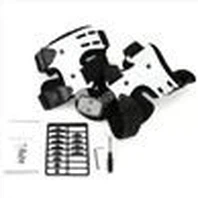
2.1 Limiting orthotics can be divided into frame type and hinge type [4]. The indications for limit orthotics are: preoperative and postoperative fixation and rehabilitation treatment of the knee joint, knee joint fractures, ligament injuries, knee joint flexion spasms, acute soft tissue injuries, patellar fractures and dislocations, lateral instability of the knee joint, external fixation of other knee joint symptoms, and knee joint limit effects, used to prevent other structural damage and functional disorders of the knee joint caused by long-term joint instability and knee joint degenerative changes [5]. Orthotics include molds made based on the characteristics of the patient's knee joint and limited disc knee hinges [6]. The limited disc knee hinge can provide stable and comprehensive fixation of the knee joint at different angles, allowing the knee joint to perform flexion and extension movements within multiple angle ranges.
Longyuan Journal Network http://www.qikan.com.cn
2.2 Adjustable knee joint orthotics Adjustable knee joint orthotics are available in left and right models, limiting the movement of the knee joint towards the inside and outside, and ensuring safety
Retaining the flexion function of the knee joint. The adjustment range of the knee joint is 0 ℃ -90 ℃, which can be adjusted according to the progress of the rehabilitation plan
Activity level [7]. After wearing, it can provide stability and fixation, support and protection, assistance in movement, prevention of deformities, and weight-bearing
effect. In recent years, digital chuck adjustable orthotics have been widely used. The digital chuck adjustable support is generally fixed by the thigh
It consists of a piece, a calf fixing piece, and a digital adjustment chuck. The fixing parts are made of lightweight aluminum alloy material, lined with breathable sponge pads (for the purpose of
To prevent skin compression, the nylon buckle strap is fixed to the thighs and calves. The digital adjustment chuck can adjust the extension of the support to 0-90 ° and the bending to
0
[8]. The orthotic components meet the requirements of knee joint dynamic and static structures. Can be considered normal in key activities
Joints and muscles provide effective range of motion, while enhancing local stability and allowing the knee joint to move within the protective range of braces
Move to prevent adhesion and contraction of the posterior joint capsule.
Clinical application effect of 3 knee joint orthotics
Search for relevant articles on CNKI using the keywords "knee joint" and "orthotics". At present, there are relatively few clinical studies on limit orthotics in China, with only one article, while there are more clinical studies on adjustable knee joint orthotics. This also indicates that adjustable knee joint orthotics are favored by clinical doctors and patients due to their convenience, safety, and reliability.
A clinical study conducted by Zhang Dianzhong et al. on 52 patients with knee joint ligament injuries who underwent postoperative installation of knee joint limit orthotics showed that wearing knee joint limit orthotics after surgery has a significant promoting effect on knee joint range of motion, stability, and overall functional recovery. However, due to the lack of control and adherence to randomized allocation principles, the credibility of the results is low, and more clinical studies on limit orthotics are expected.
There are many clinical studies on adjustable knee joint orthotics. One study conducted by Li Zhaoqing et al. [11] applied adjustable knee joint braces to 35 postoperative patients with tibial plateau fractures, followed up for 4-16 weeks. The treatment results were evaluated according to Lu's postoperative knee joint function evaluation criteria [12]: excellent: normal knee joint function, no pain, no muscle atrophy, free walking, no difficulty in flexion, extension, and squatting. Good: Knee joint function is close to normal, no pain, mild muscle atrophy, walking freely, slightly poor squatting. Can: Sometimes painful, with muscle atrophy, limited flexion but greater than 90 °, no limping when walking flat, inconvenient going up and down stairs and squatting. Poor: Pain, muscle atrophy, less than 90 ° flexion, limping, difficulty squatting. The clinical observation results showed that 18 cases (51.43%) were excellent, 14 cases (40%) were good, 3 cases (8.57%) were fair, and 0 cases (0%) were poor, fully demonstrating the significant importance of the application of joint braces for sports trauma and postoperative rehabilitation.
The current situation of knee joint orthotics in China
In recent years, China's prosthetic and orthotic industry has developed rapidly, with various knee joint orthotics being introduced one after another, but there are also many problems among them [13].
Firstly, there are few varieties and production quantities of orthotics in China, which cannot meet the clinical needs of orthopedics and rehabilitation medicine. According to incomplete statistics, the demand rate for orthotics in China is only 28.9% [14], which is much lower than the utilization rate of orthotics abroad. Although some orthopedic, rehabilitation centers, and comprehensive hospitals in China have self built or cooperated with orthotic assembly manufacturers and individuals to establish a number of small-scale orthotic rooms that can closely cooperate with medical work, most of these orthotic rooms lack technical guidance and supporting supply of orthotic components and specialized materials. Secondly, there are few orthotic assembly mechanisms and no professional technicians, resulting in differences between large, medium, and small cities
Longyuan Journal Network http://www.qikan.com.cn
Uneven distribution and lack of corresponding medical quality inspection system. Finally, and most importantly, there is a lack of understanding among patients and clinical doctors, which has led to insufficient recognition of the necessity and importance of orthotics in medical practice among the medical community, rehabilitation workers, and society in China, affecting the normal application of orthotics in medical work. Clinical doctors should fully utilize orthotics on their patients to improve their quality of life.
The above problems are not only present in the use and promotion of knee joint orthotics, but also in the entire rehabilitation medicine community.
5 Summary
Although we are facing many difficulties and there is still a lot of work to be done, the future is bright. With the development of computers and polymer materials, knee joint orthotics are no longer traditional plaster or wooden splints. The application of memory alloys [15] and other materials will bring a leap forward in the orthotics industry. The organic combination of computer 3D imaging and the production of orthotics enables personalized knee joint orthotics based on the characteristics of each patient's knee joint. The development potential of knee joint orthotics is unlimited. We should closely monitor the development of orthotics abroad and gradually make our own orthotics keep up with the pace of foreign development.
The cultivation of practical and service-oriented students should be taken as the breakthrough point for the experimental teaching of "Fundamentals of Nursing", and new curriculum objectives should be formulated, that is, each operation and behavior should reflect the concept of humanized nursing services, while explaining the purpose of each nursing operation, explaining the methods of each nursing operation, accurately and standardly completing each nursing operation, evaluating and solving patients' health problems, paying attention to the feedback of patients' service effects, and implementing effective health education for patients and their families.
2. Construct a new curriculum structure and content. Increase the proportion of laboratory courses and highlight practical features. The course content focuses on cultivating students' humanized nursing abilities, based on strengthening experimental skills and offering comprehensive courses. The internship arrangement of comprehensive experimental projects is carried out, and interdisciplinary humanistic knowledge such as psychology, ethics, sociology, aesthetics, and professional ethics are comprehensively utilized to apply the nursing concept of "putting human health at the center" to nursing experiments.
Longyuan Journal Network http://www.qikan.com.cn
2. 3. Optimize the pre class design of experimental courses. Based on students' knowledge structure and thinking patterns, incorporate innovative spirit into teaching objectives, and develop teaching objectives that are moderately difficult, practical, assessable, and scientifically reasonable. In designing lesson plans, one should be good at exploring the role of various knowledge points in cultivating innovative spirit in textbooks, selecting the best teaching starting point, refining teaching content, and improving learning efficiency. Require students to preview the experimental content, understand the experimental steps and key operational links, and organically integrate knowledge with practical operational abilities through pre class preview and participation in the preparation process of experimental materials.
2. Improve the teaching methods for laboratory courses. The key is to highlight the position of students in teaching, fully tap into their subjectivity and initiative, and reflect the transformation of teachers' tasks and roles. Reform the previous three-stage experimental teaching model of "teacher demonstration student simulation practice teacher guidance", adopting flexible and diverse teaching methods led by teachers and student-centered. Adopting heuristic, discovery based, discussion based, and research-based teaching methods, problem-based teaching, situational teaching, example based teaching, and inquiry based teaching are introduced into the classroom. Through methods such as questioning, clarification, and guidance, students are inspired to think, promote their self-development, and improve their practical ability to analyze and solve problems.
2. 5 innovative experimental teaching methods. Establish a nursing experimental center to achieve resource sharing. To make up for the lack of classroom time, the laboratory implements open management, which not only ensures normal experimental teaching but also provides conditions for students to practice after class. Changing the traditional teaching methods of teacher demonstrations and student repetitive training, introducing computer-aided instruction (CAI), integrating electronic lesson plans, slides, photos, videos, CAI courseware, training simulation systems, networks, etc. into nursing basic practical teaching, enhancing students' ability to form operational skills in the classroom.
2. Establish a sound evaluation system for experimental teaching. Reform the examination into several parts for evaluation, including theory, practical operation, and comprehensive ability, and establish corresponding scoring standards. Theoretical papers highlight the evaluation of non intellectual factors such as learning motivation, attitude, and interest; In practical operation, attitude indicators include appearance, behavior, facial expressions, language, and expression, while skill indicators include material preparation and operating procedures. The expected results are the overall evaluation of the effect; Comprehensive ability to set medical records, simulate scenarios, evaluate how students communicate and interact with patients, how to meet patient needs, and observe students' ability to reorganize and integrate their professional knowledge.
In summary, building a pyramid structure with width (rich experimental content), thickness (basic and comprehensive experiments), and peaks (learning capacity, innovation height) is a major practical task for cultivating new nursing talents with strong practical ability and innovative spirit, and is of great significance for achieving nursing education goals.