Knee supports incorporate shock absorption through material engineering, structural design, and biomechanical principles. Below are the key mechanisms and technologies used to reduce impact forces on the knee joint:
1. Material-Based Shock Absorption
Elastic Foam & Gel Pads
Memory Foam: Compresses under pressure to dissipate impact energy (e.g., patellar gel pads in running knee sleeves).
Silicone Gel: Acts as a cushioning layer between the joint and external forces (common in osteoarthritis braces).
EVA (Ethylene-Vinyl Acetate): Lightweight, flexible foam used in straps or padding to absorb vibrations during high-impact activities.
Viscoelastic Polymers
Materials like TPU (Thermoplastic Polyurethane) or TPE (Thermoplastic Elastomer) deform under load, converting kinetic energy into heat to reduce shock transmission.
Compression Fabrics
Elastic fabrics (e.g., nylon-spandex blends) apply gentle pressure to stabilize muscles and tendons, reducing micro-vibrations during movement.

2. Structural Design Innovations
Impact-Dispersing Zones
Gradient Compression: Tightest around the knee joint to direct forces upward, redistributing impact away from sensitive areas (e.g., Achilles tendon supports).
Hexagonal/Polygonal Padding: Honeycomb-shaped pads (e.g., McDavid's HexPad®) use geometric structures to absorb and disperse multidirectional forces.
Air Chambers & Pneumatic Systems
Inflatable air cells (e.g., DonJoy's Breg Fusion XT brace) allow users to adjust cushioning levels, creating a customizable shock-absorbing barrier.
Articulated Hinges
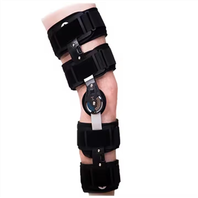
Rigid hinges with spring mechanisms (e.g., Bauerfeind GenuTrain) mimic natural joint movement while dampening lateral and axial shocks.
3. Biomechanical Principles
Muscle Activation Support
Compression sleeves enhance proprioception (joint awareness), helping muscles react faster to uneven surfaces, reducing sudden impacts.
Joint Alignment Correction
Supports with medial/lateral reinforcements (e.g., straps or rigid stays) align the patella and tibia, preventing misalignment-related stress during impact.
4. Advanced Technologies
D3O® Adaptive Foam
A smart material that remains flexible under normal movement but hardens upon impact, used in high-performance sports braces.
Poron® XRD®
Ultra-thin, high-density foam that absorbs up to 90% of impact energy, often layered under silicone pads for dual cushioning.
Carbon Fiber Reinforcement
Lightweight carbon fiber plates in braces (e.g., Ossur CTi) provide rigid support while flexing to absorb repetitive shocks.
5. Application-Specific Solutions
Running/Jumping Sports
Focus on dynamic compression and breathable gel pads (e.g., Nike Pro Knee Sleeve) to handle repetitive landings.
Weightlifting
Use rigid hinged braces with TPU bumpers to absorb forces during squats or cleans.
Medical Rehabilitation
Gel-infused sleeves (e.g., Shock Doctor) combine compression and cushioning for post-surgery impact protection.